Before the First Storm: Rehearsing Broadband Failover in a Single Working Session
Photo: Unknown, No restrictions, via Wikimedia Commons
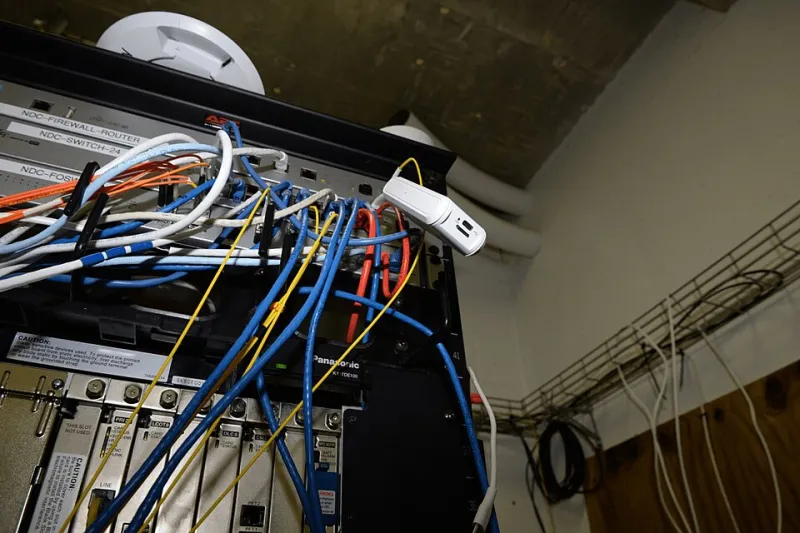
Most small UK firms now possess some form of broadband redundancy. A second line may sit in the comms cabinet, a 4G or 5G router may be plugged in but rarely used, or a managed service provider may hold a promise of diversion. The hardware is not the weak point. The weak point is the assumption that it will work when the weather, a roadworks crew or a failed fibre joint removes the primary connection without warning.
Winter is a useful deadline. Storms do not create new weaknesses; they reveal the ones that have been present since the last change. A 90-minute drill, run during ordinary business hours, turns a dusty contingency document into a rehearsed routine. It need not be elaborate, and it should not require a full business continuity exercise. The aim is to answer one question: if the main line dropped now, what would actually happen, and who would know what to do?
Set the conditions before anyone touches a cable
Choose a quiet but representative period, ideally when at least one remote worker and one customer-facing team are active. Tell enough people that a drill is taking place to avoid alarm, but do not rehearse the steps with them beforehand. The value lies in observing the first response, not a scripted performance.
Confirm that the backup router has power, an active SIM or line, and a current configuration. Check that the failover method is understood: automatic routing, manual cable swap, or a change on the firewall. For many SMEs the backup is not truly automatic, and staff may be waiting for a recovery that will not occur on its own.
Appoint three roles for the session: a drill lead to keep time, a technical operator to make the change, and a scribe to record timings and exceptions. If the firm has an IT provider, invite them but do not let them run the entire exercise. The point is to test the firm’s own readiness, including its ability to contact the provider when the usual channels are disrupted.
The 90-minute timetable
Use a simple clock and keep to these blocks.
Minutes 0–10: Confirm the baseline. Record the current status of the primary connection, the backup connection, the phone system, the card terminal and two critical cloud applications. Note the time. This baseline is what the drill will be measured against.
Minutes 10–25: Simulate loss of the primary line. Disconnect the primary connection at the router or ask the provider to place the line in a test state. Do not merely switch off a desk phone. Observe what happens without intervention for the first five minutes. Does the backup activate? Do users receive any message? Does the phone system fail over, or do calls simply stop?
Minutes 25–45: Bring the backup into service. Follow the documented procedure exactly as written. If the procedure is wrong or incomplete, stop and record the gap. Test a VoIP call inbound and outbound, a card payment for a nominal amount if the terminal supports test mode, access to cloud email and one operational system, and a video call from a remote worker. Test at least one customer-facing channel, such as the main number or a contact form.
Minutes 45–60: Test the human path. Ask a remote worker to connect as they would on a normal working day, without special instructions. Ask the person who handles customer enquiries to explain what they would tell a caller. Check whether the published contact number still reaches someone. If the firm uses a call diversion, confirm who can activate it and from what device.
Minutes 60–75: Restore the primary connection. Return to normal service and observe how systems recover. Record any sessions that do not resume, any phone registrations that fail, and any card terminal that needs manual attention.
Minutes 75–90: Review and assign actions. Gather the drill lead, operator and scribe. Compare the actual timings with the pass/fail measures. Record no more than five actions, each with a named owner and a date. A long list will not be completed; a short list might be.
Pass/fail measures that mean something
A drill without measures becomes an anecdote. Use a small set of binary checks.
- The backup connection carried VoIP calls in both directions within 15 minutes of the primary loss.
- A card payment was completed, or a documented workaround was available and understood.
- Remote staff could reach the two critical cloud applications without a support call.
- The main customer contact route remained answerable, or a diversion was activated within 10 minutes.
- The restoration procedure returned all tested services without specialist intervention.
- The written procedure matched the steps actually required.
A single failure is not a crisis. It is the reason for drilling. The important output is a dated record showing what failed, who owns the fix and when the next drill will take place. Keep that record with the contingency plan, not in a folder that only the IT provider can see.
Make it a routine, not an event
Repeat the exercise before the winter period and again before any major change, such as a switch to a new VoIP platform or a move to a different office. Rotate the scribe and the drill lead so that knowledge does not sit with one person. If the firm has multiple sites, test the site that would cause the most customer disruption, not the one that is easiest to reach.
The objective is operational confidence. A backup router in a cupboard is a component. A team that has used it, timed it and fixed what it found has a contingency. The difference is usually settled in 90 minutes, well before the first storm arrives.