Runtime Is a Claim: Testing What Your UPS Really Carries Before Winter
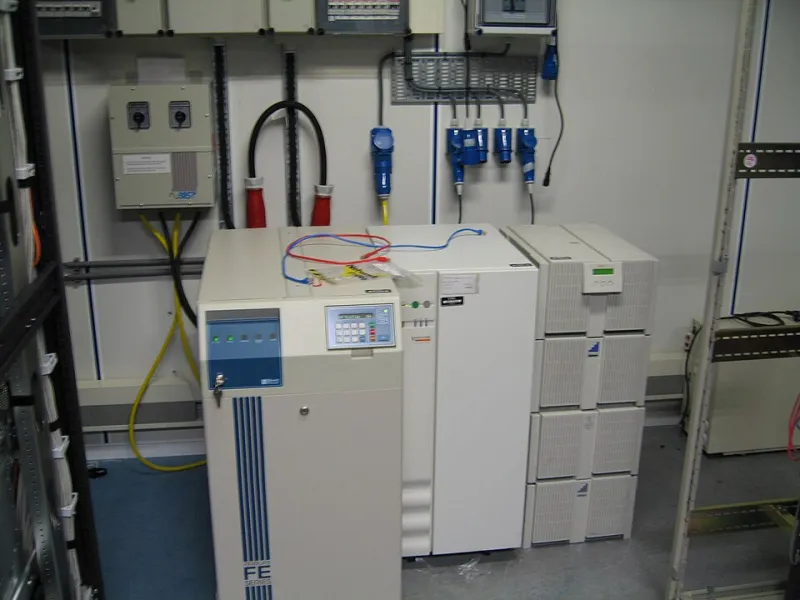
Photo: Jemimus, CC BY 2.0, via Wikimedia Commons
The light proves very little
Most uninterruptible power supplies will happily report a green indicator after a brief self-test. That test demonstrates that the inverter can take over from mains for a few seconds under whatever load happens to be connected at the time. It does not demonstrate runtime. It does not prove that the management card will send a warning. It certainly does not prove that a file server, a NAS appliance, a router and a PoE switch will shut down in the right order when the battery reaches its configured threshold.
For UK SMEs, the risk is seasonal but not mystical. Winter brings a higher likelihood of storm-related supply faults, local distribution failures and short interruptions that expose weak ride-through capacity. A UPS that carried the load comfortably three years ago may now be supporting twice the equipment on a battery approaching the end of its service life. The only credible way to know what survives a power cut in 2026 is to measure it under controlled conditions.
Set the scope before touching anything
Treat the exercise as a planned operational drill, not an ad hoc experiment. Choose an out-of-hours window, notify the affected users, and confirm who has authority to restore mains if something does not behave as expected. Identify the critical circuits and the equipment connected to each UPS. Record the battery installation date, the last self-test result, the management card status and any existing shutdown agents.
Before the drill, capture a baseline load in watts and volt-amperes from the UPS display or management software. Note the ambient temperature in the room; battery performance is sensitive to it. If the site has a maintenance bypass, use it only where qualified staff are available and the transfer procedure is documented. Life-safety, fire and security systems should not be brought into an IT drill unless the responsible owner has explicitly agreed the method and fallback.
Build a representative load
The temptation is to test with a convenient load that is easy to isolate. That produces a convenient number, not a useful one. The drill should reflect what the UPS actually carries during a working day: servers, core switches, routers, NAS units, PoE switches, door controllers, telephone equipment and any small network appliances that everyone forgets until they stop.
Where production cannot be interrupted, test in stages or use a load bank for a preliminary capacity check. A load bank is useful for establishing battery behaviour, but it does not validate shutdown orchestration. The more valuable test is the one that runs the real equipment through a controlled sequence.
A one-hour sequence
Allow roughly an hour. In the first five minutes, confirm the scope, the communication route and the restore procedure. Spend the next ten minutes recording baseline load and checking that management alerts reach the agreed recipients. Then initiate the test.
Do not aim for a full discharge. For valve-regulated lead-acid batteries in typical SME installations, a deep discharge adds risk without adding much operational value. Set a planned stop point, such as 50 per cent remaining capacity or fifteen minutes, whichever comes first. Record the time to the first low-battery warning and the time at which the shutdown threshold is reached. At that point, trigger the graceful shutdown deliberately and observe what actually happens.
Watch the servers, the NAS, the router and the PoE equipment separately. Confirm whether each device received the signal, whether the operating system or appliance completed its shutdown, and whether the network remained available long enough for alerts to leave the building. Restore mains, confirm that the UPS returns to normal operation and begins recharging, then bring services back in the documented order.
Shutdown is a chain, not a tick box
A UPS without working shutdown integration is a battery with a countdown. Servers need an agent or an authenticated management connection. NAS appliances often rely on NUT, SNMP or a vendor-specific integration. Routers and firewalls may not need to shut down at all, but they do need to stay powered long enough to pass alerts. PoE switches deserve particular attention: cameras, handsets and access controllers can consume more runtime than the IT team expects, and the PoE budget on the datasheet is not the same as the measured draw.
Document the shutdown order. Non-critical systems should go first. Virtual hosts, storage and directory services need a sequence that avoids corrupting data or leaving authentication unavailable during restart. If the UPS supports multiple outlet groups, use them to separate equipment that should remain up from equipment that should be powered down early.
Record what failed, not just what passed
The output of the drill should be evidence. For each UPS, record the model, battery date, measured load, measured runtime to warning, measured runtime to shutdown threshold, systems covered, shutdown result and any anomaly. Note the date, the staff present and the restore time. Keep the record with the business continuity material, not in a personal notebook.
Common findings include expired batteries, equipment plugged into the wrong outlet, management cards that were never configured, shutdown agents using stale credentials, NAS devices that ignore the UPS signal, PoE loads that dominate runtime, and routers connected to a bypass socket. These are exactly the details that determine whether a short outage remains an inconvenience or becomes a recovery exercise.
Close the loop before the first storm
After the drill, update the asset register, the labels and the runbook. Replace batteries that no longer meet the required runtime. Move non-critical loads off critical UPS outlets. Adjust shutdown thresholds where the measured behaviour differs from the design. Schedule the next quarterly check and record the residual risk in plain language for decision-makers.
A UPS is not a guarantee of continuity. It is a defined quantity of energy attached to a defined set of dependencies. The winter drill turns that definition into something the business can rely on, and it replaces the comfort of a green light with a measured answer.